
The Garden Trick That Cuts Pests, Builds Soil, and Boosts Harvests — Without Buying a Single Thing
Most gardeners fight the same problems every year. Rotating your crops breaks the cycle.

There’s a point many gardeners reach after a few successful seasons where things suddenly begin to shift.
The tomatoes don’t thrive the way they used to.
The squash struggles.
Pests arrive earlier.
Disease spreads faster.
Harvests shrink.
And somewhere in the middle of it all, you start wondering what changed.
When we first begin gardening, fresh soil and untouched ground often carry us through those early years with surprising abundance. But over time, the garden begins responding to the patterns we’ve created within it.
One of the simplest ways to restore balance — and improve your harvests naturally — is through crop rotation.
Not complicated systems.
Not expensive inputs.
Just learning to move crops thoughtfully through the garden from season to season.
Why crop rotation matters
Soil health is a lot like our own health.
When we nourish ourselves well, move our bodies, rest deeply, and live in rhythm with what we need, life tends to function with greater ease. We have more energy. More resilience. More capacity.
The garden is no different.
Healthy soil supports stronger plants, greater harvests, fewer pest problems, and less work for the grower over time. And for those of us pursuing a slower, more self-reliant life, that matters.
Because the goal isn’t simply to work harder in the garden.
It’s to create systems that support abundance with less strain year after year.
Crop rotation is one of those systems.
What happens when we grow the same crops in the same place
Every plant pulls something different from the soil.
When we plant the same crop (or family of plants) in the same bed season after season, those specific nutrients become depleted more quickly. Eventually the soil struggles to support healthy growth.
But nutrient depletion is only part of the story.
Pests and diseases also begin establishing themselves in that space.
Many insects, fungal issues, and soil-borne pathogens are crop-specific. When their preferred host plant returns to the exact same location each year, their lifecycle continues uninterrupted. Populations increase. Problems compound.
This is often why gardens seem to “suddenly” decline after a few productive years.
Crop rotation interrupts that cycle.
When we move plant families to a new area of the garden, pests and diseases lose their reliable food source. The soil has time to recover. Nutrient demands shift. Balance slowly returns.
Some plants actually improve the soil
One of the beautiful things about gardening is that not all plants take from the soil in the same way.
Some crops — especially legumes like peas and beans — help return nitrogen back into the soil, making it available for future crops.
Others, like carrots or daikon radish, send deep taproots down into compacted ground, helping improve soil structure and water absorption naturally.
When we rotate crops intentionally, we allow different plants to contribute different things to the garden over time instead of continuously asking the soil for the same resources.
Healthier soil creates healthier plants
Healthy soil is alive.
Beneath the surface there’s an entire ecosystem of fungi, bacteria, worms, and microorganisms working constantly to support plant health. Crop rotation helps strengthen that ecosystem by encouraging diversity rather than repetition.
And often, when plants struggle with disease, what we’re really seeing is soil that has become imbalanced over time.
The garden is communicating.
Not failure.
Not a lack of skill.
Just a system asking for restoration.
A simple way to begin crop rotation
You do not need a perfect chart or complicated plan to start.
Simply begin by grouping crops by family and avoiding planting them in the same space year after year.
For example:
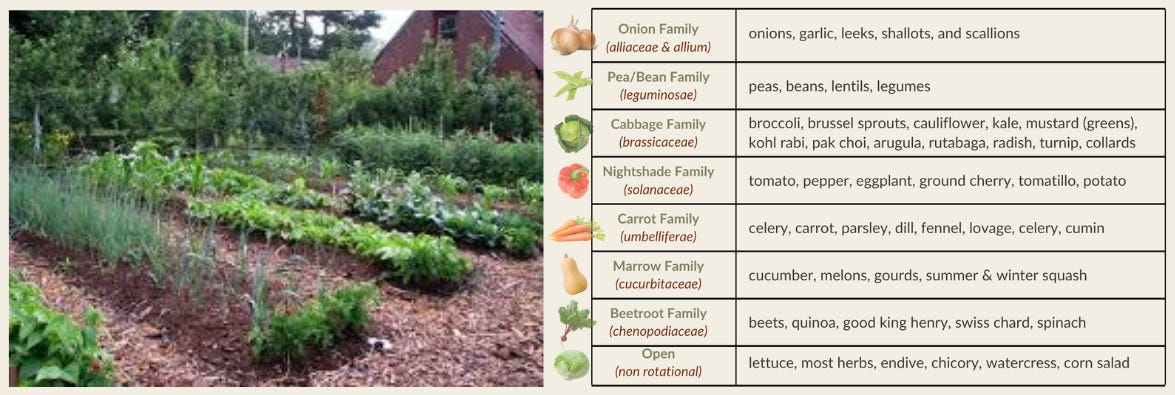
Tomatoes, peppers, potatoes, and eggplant belong to the nightshade family.
Cabbage, kale, broccoli, and cauliflower belong to the brassica family.
Peas and beans are legumes.
Carrots and dill belong to the umbel family.
Even rotating crops on a simple 3–4 year cycle can make a noticeable difference in plant health and harvests over time.
Start small.
Pay attention.
Observe your soil.
Gardening becomes far easier when we stop working against natural systems and begin partnering with them instead.
And often the healthiest gardens are not the most complicated ones — just the ones tended consistently, season after season, with patience and care.
How to Rotate Crops
Let’s keep this as simple as possible.
Gardening should not leave you feeling like you need a master’s degree to understand it.
Implementing crop rotation in a home garden requires little more than a notebook, a pencil, and a willingness to observe what happens in your soil from season to season.
Understanding what plants give and take
Each plant family falls loosely into one of three categories:
Heavy feeders
Light feeders
Soil builders
This matters because every crop interacts with the soil differently.
Some plants draw large amounts of nutrients from the ground. Others help restore nutrients or improve soil structure. When we understand those patterns, we can rotate crops in a way that keeps the garden balanced and productive over time.
For example:
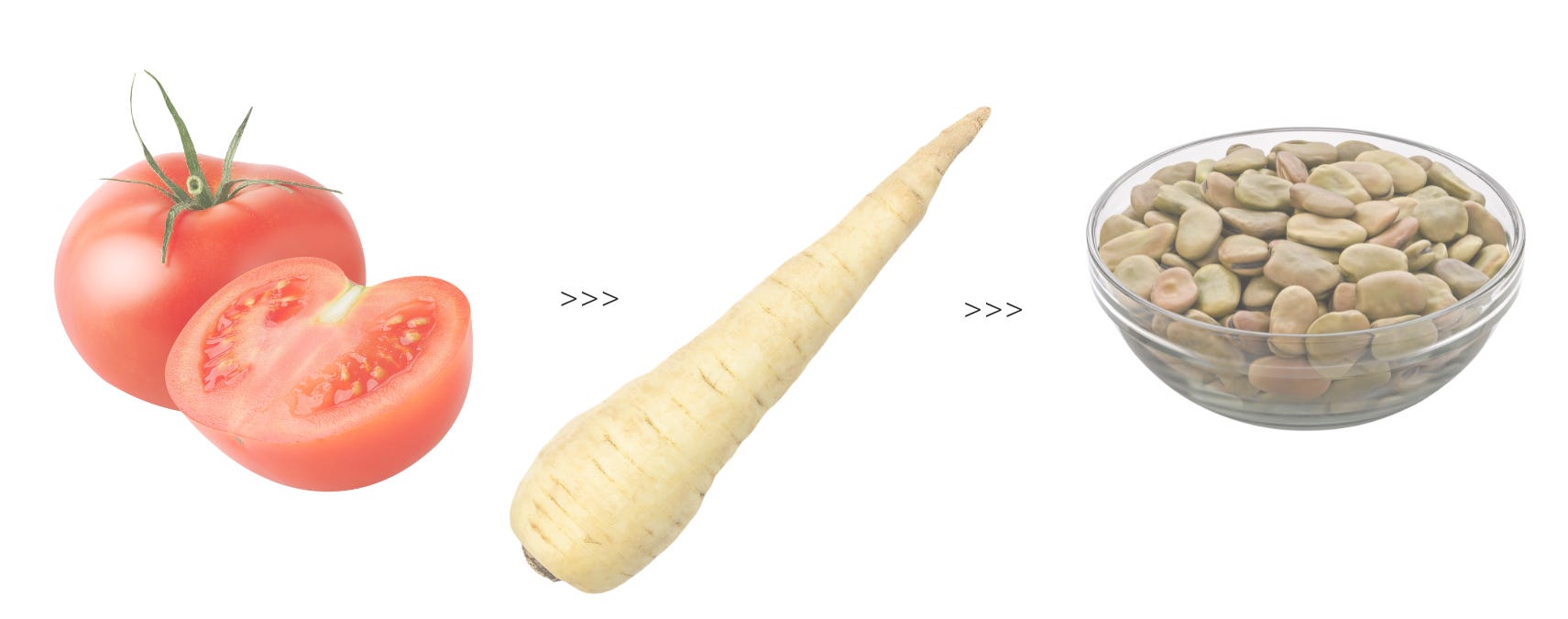
Tomatoes are heavy feeders that use large amounts of nitrogen and phosphorus.
Root crops like parsnips draw heavily on calcium and potassium.
Legumes such as peas and beans help return nitrogen back into the soil.
When we rotate crops intentionally, we help counterbalance what the previous season removed. Instead of continuously depleting the same nutrients year after year, we create a cycle of giving and taking that supports healthier soil naturally.
This is one of the foundations of long-term garden health.
Planning your rotation
The chart below will help you begin mapping out your garden rotation.
Rotating your rows or beds from year to year helps prevent nutrient depletion while also reducing the buildup of pests and disease associated with specific plant families.
Our goal is not simply to grow vegetables.
It’s to create a healthy ecosystem between soil and plants — one that can continue producing abundant harvests without relying heavily on synthetic fertilizers or constant intervention.
For example:
If tomatoes are planted in one area during year one, root crops may follow the next season, with legumes planted after that.
Over those three seasons, the soil experiences both nutrient use and nutrient replenishment. By the time tomatoes return to that space again, the soil has had an opportunity to recover and rebuild what those heavy-feeding crops require.
Crop rotation by plant family
For simplicity, we are focusing on six of the most common plant families found in home gardens.
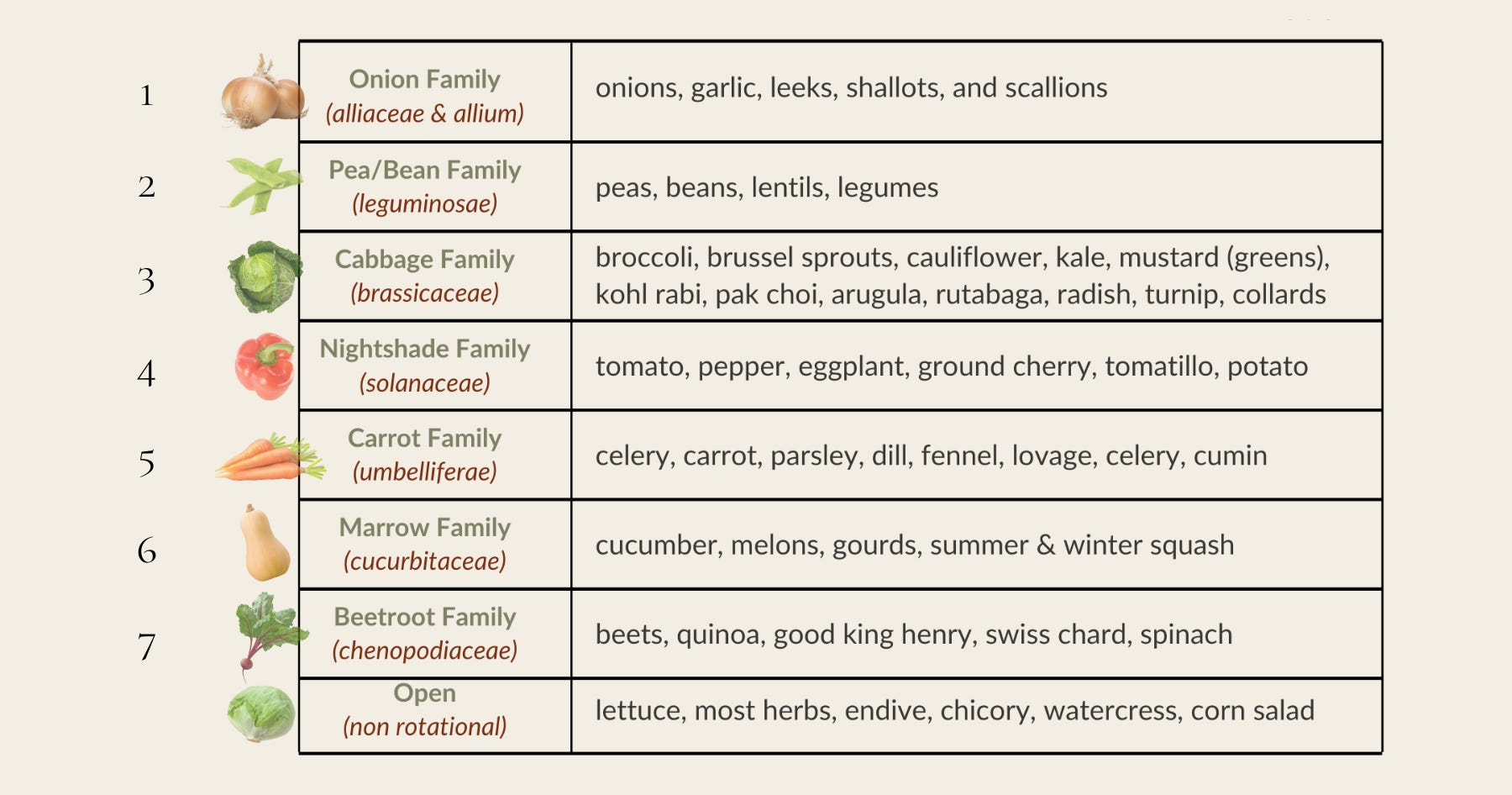
There are many additional plant families, but some contain only a few crops or are less commonly grown in backyard gardens. Perennial crops are also omitted since they typically remain in the same place year after year.
There are several simple ways to implement crop rotation:
From row to row
Between raised beds
By dividing rows lengthwise
Through succession planting during the growing season
Ideally, crops should not return to the same space for at least three growing seasons. If you have enough room to create a longer rotation, a full seven-year cycle is excellent for soil health.
But even small gardens benefit tremendously from simple rotation practices.
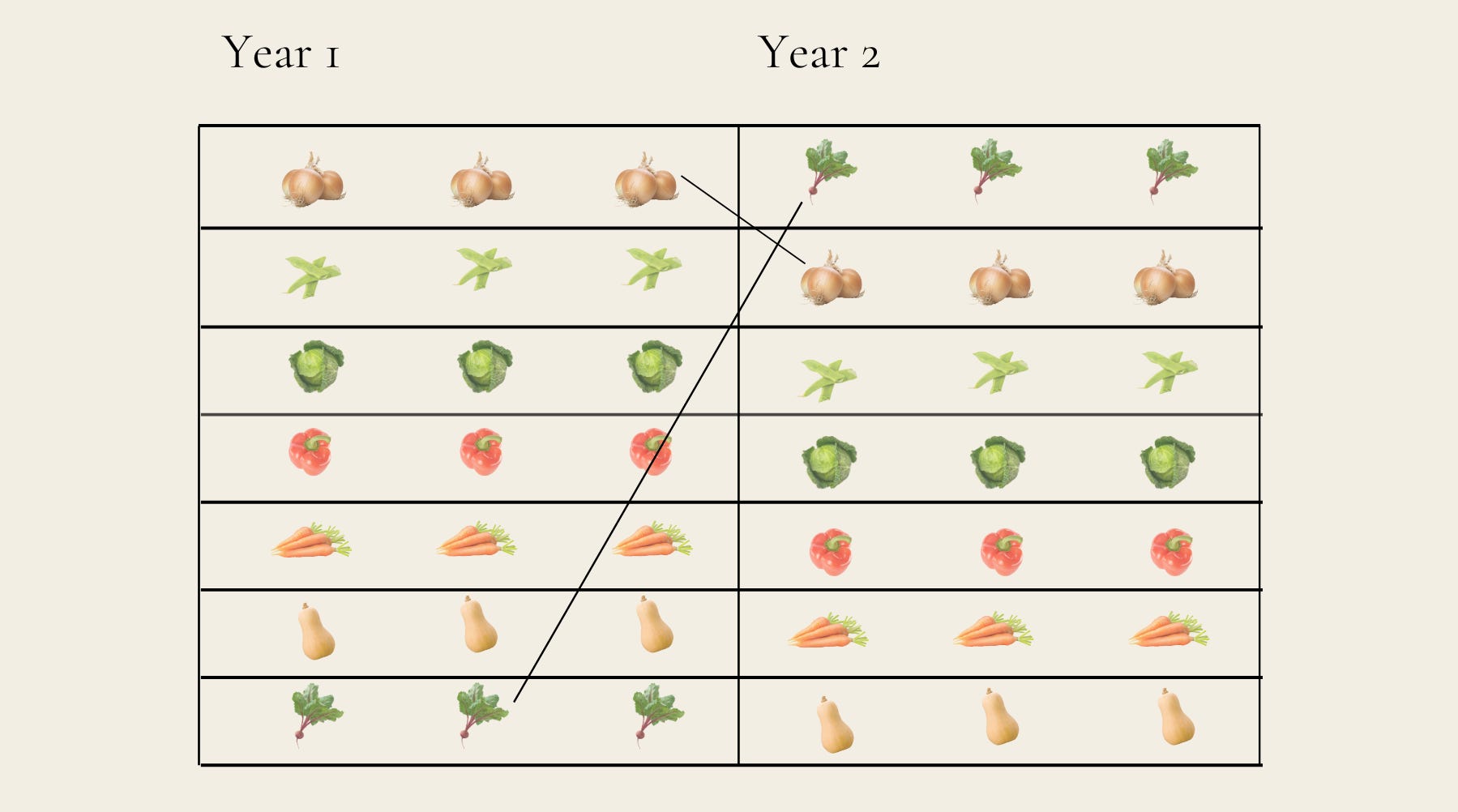
Garden rows for crop rotation
Each year simply shift each plant family over one row.
If you are using beds vs rows apply the same principles.
For small-space gardeners
If your growing area is limited, don’t worry. Crop rotation is still absolutely worthwhile.
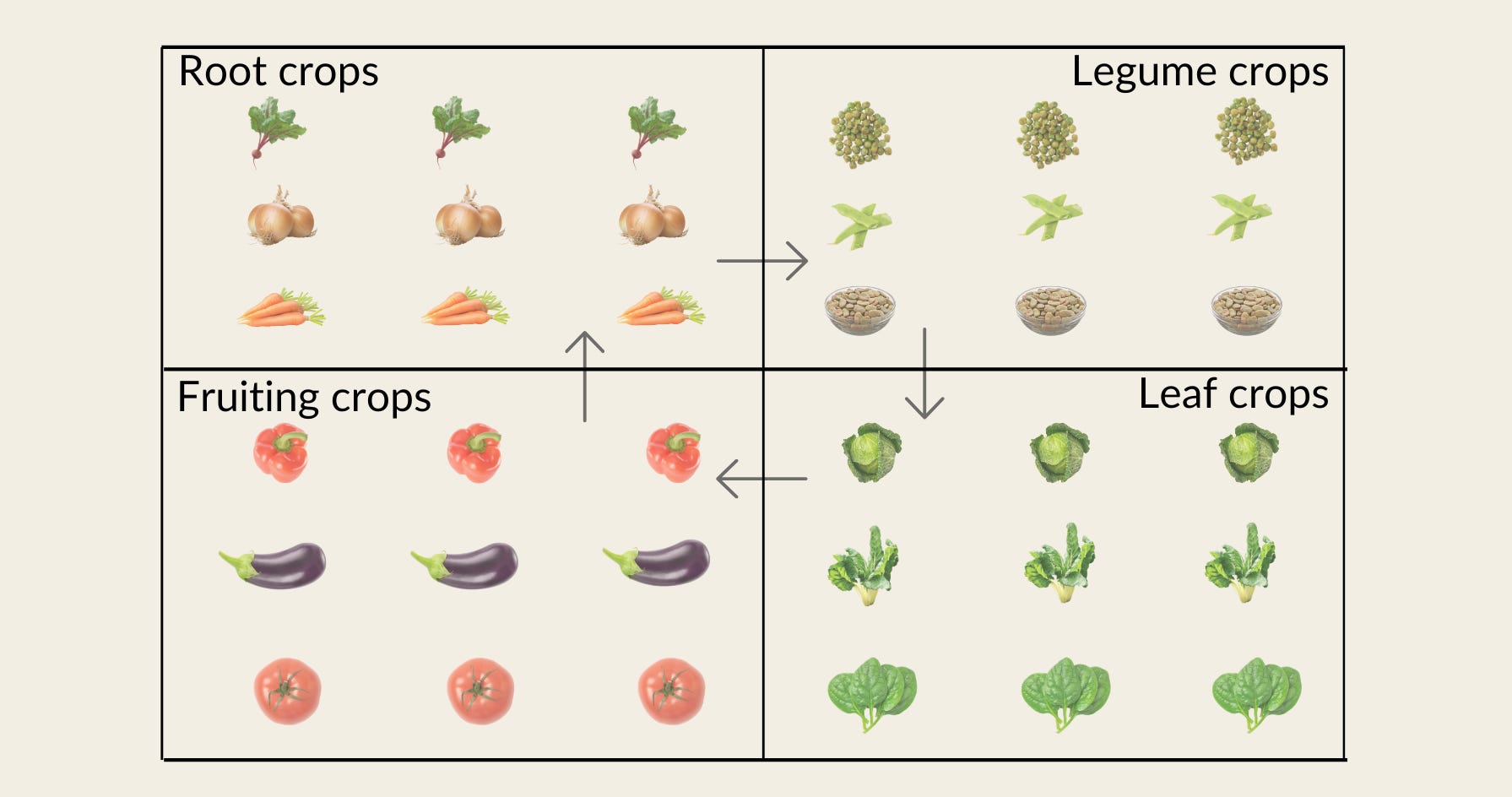
A simple method is to divide your crops into four basic groups:
Legumes
Root crops
Fruiting crops
Leaf crops
From there, create four growing spaces. This can be done with raised beds, divided garden rows, containers, or even sections within a single bed.
Each year, simply rotate the plant groupings into the next space.
Even this very simple system can dramatically improve soil health and reduce pest and disease pressure over time.
A slower way of gardening
Crop rotation is not a new idea.
In many ways, it’s as old as gardening itself.
Long before charts and gardening books, people learned through observation. They noticed which crops exhausted the soil, which seemed to restore it, and which areas of the garden struggled when the same plants returned again and again.
And perhaps that’s the real invitation here.
To slow down enough to notice what the garden is telling us.
My hope for you is not simply a larger harvest, though I hope you have that too.
I hope gardening leaves you feeling connected. Grounded. Fulfilled.
Because healthy gardens are rarely built through perfection.
More often, they’re built through attention, patience, and small rhythms repeated over time.
I’d love to know how you approach crop rotation in your own garden.
Do you map everything out carefully each season, or has your system become something more intuitive over time?
And if you’re new to this practice, what part feels most confusing or overwhelming right now?
I think some of the best gardening knowledge still comes from simply sharing what we’ve noticed with one another.
-Angie
Crop rotation is essentially a farming technique. It works best if the relevant fields are a few miles or kilometres apart. In gardening, it makes sense in large gardens with spacious beds that rely on monoculture. Think gardens that used to feed big households of ten people and more. No frills, food-or-we-go-hungry gardens.
In small modern gardens, especially if you use neighbour planting techniques like Franck‘s or Langerhorst‘s, if you also have spring, summer, and winter cultures going, crop rotation isn‘t a big issue.
If you‘re looking at mobile pests, they will find the new home of your carrots even if you moved it to the other side of the garden. If you suffer from a severe soil affliction like cabbage club root, moving your cabbage one metre or just a foot won‘t help at all.
Avoid monocultures. Favour neighbour planting. Prioritize soil health with compost and mulch. No random fertilising.
Sticking to rigid rules like "no cabbage here the next four years“ when that translates into "no more cabbage in your tiny garden“ even though your soil is healthy and you haven‘t particularly suffered from any pests makes no sense.
The thing is that in gardening it‘s not rigid, abstract crop rotation rules that will help the most, but paying attention: to the kind of garden you maintain, to the health of plants, the types and severity of pests, the health of soil.
One question that I would always ask: When did you last send a soil sample to the lab? For hobby gardeners it‘s free at events of gardening centres and around 20 Euro in a lab. Then you have a solid basis to start with.
Of course it‘s awesome if you have the space where crop rotation makes sense. My grandmother had two gardens like that. That was back-breaking labour to keep the family fed. Most people I know garden with a fraction of that space, and they are supplementing their food, not depending on their gardens for survival.
So I just want to encourage all small space and neighour planting gardeners not to panic over crop rotation. Look at you garden, your soil, your garden beds, your plants and your pests. Consider what you have done to keep the soil healthy. All of that will tell you if you can risk planting your beloved peas or zucchini in just that corner again, or if the soil needs some loving and a change of scenery for a year.
I’ve been doing a lot of companion planting. I make sure that I don’t plant heavy feeders in the same area year after year, and when we sheet mulched over grass to make a new space, I planted a winter cover crop, and this spring planted “throw away” daikon radishes that are flowering now and I’ll let them drop seeds. If it’s like I did last year in a different area, we’ll get a bumper crop of daikon next winter/ early spring, and the soil will be so happy and lush. Our soil has a lot of clay where we are, so my secret weapon has been breaking it up with daikon and being patient for a year or more until the soil is ready. I also keep notes on how crops did in different locations and compare year over year. Last year was a weird year in the garden, and 2 of my neighbors who also garden had similar notes. They’re way more experienced than I am and have been living here for 30+ years (I’m entering year 5 of gardening). Trial and error, keeping notes, companion planting and having a bee border have helped our garden tremendously. For me the garden not only feeds my family, it feeds my soul. Better than therapy.